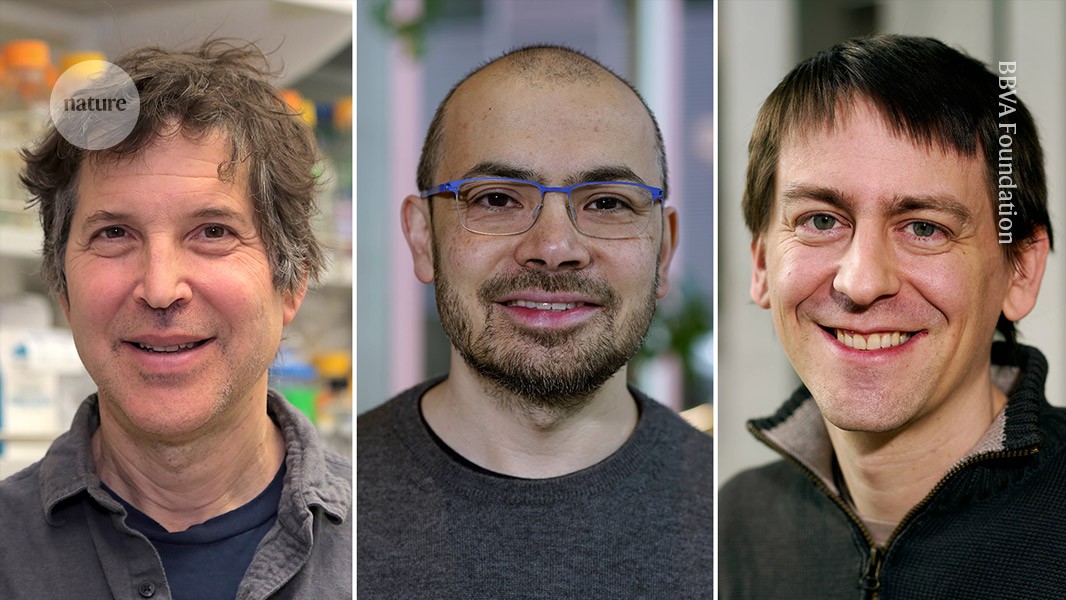

The Challenge of Three-Dimensional Protein Structure Prediction: The Orengo-Orengo Lab at University College London, and the Laureates of the 2014 Nordic Pharmacology Competition
The impact of AlphaFold was unveiled a few years ago. Experiments that were unimaginable a decade ago have been enabled by the tool, which made often, but not always, highly accurate, structures available to researchers at the touch of a button. “It’s a major revolution,” says Christine Orengo, a computational biologist at University College London, whose lab has used AlphaFold-predicted structures to uncover new proteins.
Heiner Linke, chair of the committee, said that it was a dream to learn to predict the three-dimensional structure of proteins. This year’s laureates “have cracked the code”, he added. The three winners share a prize pot of 11 million Swedish kronor (US$1 million).
Many researchers hope that AlphaFold and other AI tools it has inspired will transform medicine, but it is not yet clear how, or indeed whether, AlphaFold will streamline the costly and multi-step process of developing safe new drugs. Scientists who are working on creating new vaccines are findingAlphaFold extremely useful and game-changing. But AlphaFold is a complement to other approaches to mapping and tweaking the structure of viral proteins for use in vaccines.
Fish maws in the Papua New Guinean lagoon: climate change risk to planetary vital signs in the 21st century
It has been two decades since the launch of the space-tourism venture Virgin Galactic. Billionaires seem to be popping up to space regularly — for example, entrepreneur Jared Isaacman, who was both spacewalker and bill-payer on a recent private SpaceX mission. But what about the rest of us? Two companies that offer ultra-high altitude balloon tours are about to offer passengers a trip into thin air at a discounted price.
A surging market for ‘fish maw’ — dried swim bladders — in Papua New Guinea is a lifesaver for impoverished communities. indiscriminately catching many types of fish, dolphins and turtles with gillnets could damage the environment and leave people worse off. There are very few controls and the government doesn’t know much about the value, importance or potential threats of this. The result is a sort of cowboy frontier, in which fishers focus on species that we don’t know anything about in terms of the science.
The report concludes that a lot of the very fabric of life on Earth is at serious risk due to the climate crisis. This year, 25 of the 35 planetary vital signs have reached record levels. Most broke records last year. “It is staggering that, in a world where billions of people are already suffering from the impacts of climate change, fossil fuel emissions and deforestation rates are not slowing, but they are actually increasing,” says ecologist and co-author Thomas Crowther.
Elephants, Mice, Robots & the Environment: A Nobel Prize in Chemistry and Viruses in Rwanda (with an appendix by Adam Levine)
An elephant has a trunk. Researchers have shown that the trunk wouldn’t be what it is without it. Wrinkles appear as soon as the trunk is 20 days old and it is possible for the appendage to wrap around objects. Elephants also develop more wrinkles on one side of their trunks as they grow, depending on whether they’re ‘right-trunked’ or ‘left-trunked’.
Rwanda is experiencing one of the biggest outbreaks of the Marburg virus ever documented. Scientists expect the outbreak to be contained but warn that Marburg is on the rise with no proven treatment. People with a fruit bat can becomeTransmissions of the Virus, a “cousin” of the Epizootic Viruses, usually start after that. Climate change and other environmental threats have made people more prone to get infections from animals. “The world really has to just be ready for that,” says emergency-medicine physician Adam Levine.
We meet the winners of the chemistry prize. A damning report on the state of the climate crisis is included.
Management and marketing specialist James Muldoon questions the safety of AI companions for lonely, vulnerable users — particularly after the founder of the company behind Replika AI admitted she was inspired by an episode of dystopian TV series Black Mirror. The Conversation lasts 19 minutes.
Source: Daily briefing: AlphaFold developers share Nobel Prize in Chemistry
The end of one of the robotic arms of Curiosity, the Mars hand lens imager — a relic from 12 years of exploration
Considering that NASA’s Mars rover Curiosity has been on the red planet for over a decade, it’s understandable it’s showing signs of a little wear and tear. After 12 years of exploration, we see one of the six well-worn wheels. There is a lot of life in the old rover despite the rough surface of Mars. The end of one of its robotic arms was where the Mars Hand lens imager happened to be. (Space.com | 3 min read) (Image credit: NASA/JPL-Caltech/MSSS)